

MC-ICP-MS
Multi-Collector Inductively Coupled Plasma Mass Spectrometry
Introduction to MC-ICP-MS
A Reliable All-rounder Technique at the Cutting-Edge of Isotope Research
When efficiency and versatility matter, multi-collector inductively coupled plasma mass spectrometry (MC-ICP-MS) is the technique-of-choice for most isotope applications and laboratories. The technique combines a universal plasma source (ICP) and a sector field mass analyser design (MS) with a multi-collector array (MC) for simultaneous ion detection. The simultaneous collection of multiple ions thereby minimises susceptibility to plasma noise and input signal variations, while optimising the duty cycle during measurements compared to single collector instruments. This approach enables flexible and efficient sample introduction and data acquisition for highest precision and accuracy isotope ratio measurements of most sample types and elements. As a result, MC-ICP-MS is leading the way in the development and use of conventional and novel isotope applications across earth and life sciences, or nuclear safeguarding.
Whether solid, liquid, or gaseous – continuous introduction of any sample species into the ICP relies on transport within a carrier gas flow, allowing a variety of sample introduction methods such as pneumatic nebulisation, desolvation, laser ablation, cold vapour or hydride generation, or other gas and liquid chromatographic introduction systems to be employed. This main characteristic opens the MC-ICP-MS technique to static and time-resolved data acquisition, making it well-suited for transient signal applications such as in situ isotope or nanoparticle analysis as well as prolonged highest precision and accuracy measurements of static signals. In conjunction with autosampling devices, the flexible sample introduction enables high sample throughput and efficient workflows for many isotopic systems, making MC-ICP-MS the workhorse in many laboratories.
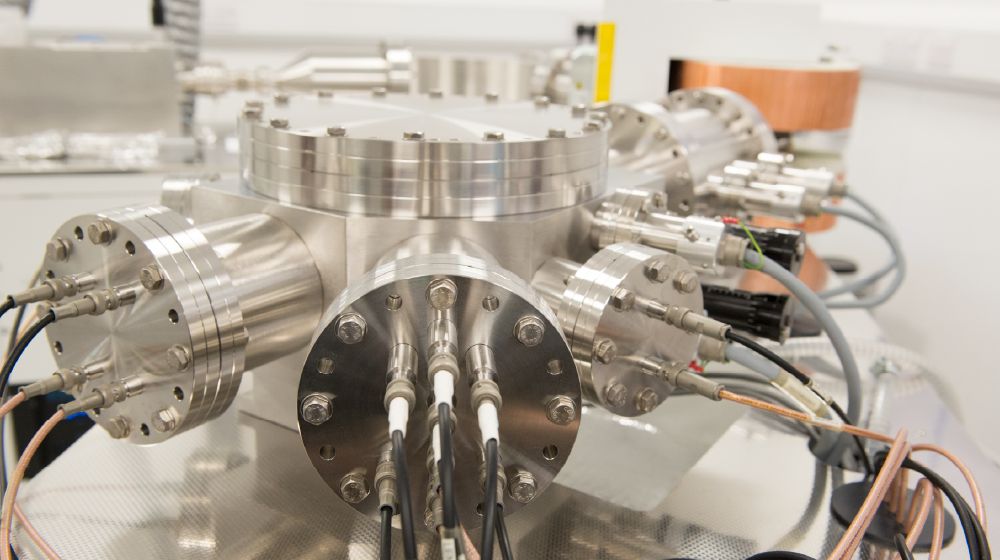
Using Electromagnetism for (Re)Defining Ion Paths
Sample ions generated at the ICP source are highly susceptible to electromagnetic fields – a basic principle that MC-ICP-MS builds upon to analyse isotopic abundances based on mass-to-charge ratios. The MC-ICP-MS technique thereby excels by flexibly integrating and combining different ion separation capabilities to address analytical challenges for isotope analysis of most elements in of the periodic table.
After extraction into the vacuum of the instrument via a high sensitivity interface with conical apertures, sample ions are accelerated and focused towards the mass analyser using electrostatic fields and variable resolution slits to generate sharp ion beam profiles. However, as sample ions generating from an ICP source exhibit a relatively large spread in ion energies limiting the focusing of the ion beam (and therewith the mass resolution), most MC-ICP-MS utilise a double-focusing Nier-Johnson geometry. The ions are thereby first focused by energy in an electrostatic analyser before separated by mass-to-charge ratios in a magnetic sector.
This double-focusing geometry enables high mass resolution capabilities, which allow for the analysis of isotope systems that suffer from plasma-based interferences such as Ar+ on Ca+, ArO(H)+ on Fe+ or ArAr+ on Se+, the inevitable byproducts of an ICP source. A combination of variable resolution slits in the beam path is thereby used to cut the edges of the ion beam profile, resulting in sharper mass peaks and the ability to physically resolve certain interferences - however to the detriment of decreased signal intensity and increased sample size requirements for these systems.
The use of multipole collision/reaction cell and magnetic mass filtering techniques in MC-ICP-MS benefits many isotopic systems and accesses additional applications and isotopes for which conventional high resolution capabilities are insufficient to physically resolve limiting interferences. Plasma- and matrix-based interferences are thereby chemically resolved by using collisional or reactive gases, i.e., polyatomic interferences are split up or neutralised (e.g., charge transfer reactions between Ar and H2 to measure K and Ca isotopes), or target isotopes or interferences can be reacted to form polyatomic species with different mass/charge ratios to resolve interferences (e.g., mass shifting Sr+ with SF6 while Rb+ does not react with SF6 to separate Sr from Rb). This approach enables high sensitivity-low resolution analysis for, e.g., K, Ca or transitional metals such as Ti, V, Cr, and Fe, or while accessing new isotopes such as 36S, 40Ca and 80Se, or allowing for novel applications such as in situ Rb-Sr dating.
The use of such capabilities provides valuable insights into climate archives such as stalagmites or sediment cores at improved spatial and isotopic resolution, or enable the study of metabolic processes in biological samples to find treatments for diseases with reduced sample preparation requirements and optimised workflows – in addition to standard applications such as Nd, Hf, or Pb isotopes. The huge potential for developing new applications puts MC-ICP-MS at the forefront of isotope analysis and research.
Making Every Ion Count – Low-Noise Amplification at the Core of Multi-Collection
Multi-collection of target ions is achieved using a number of adjacent ion detectors dedicated to individual mass/charge ratios, namely Faraday cups connected to feedback-resistor pre-amplifiers or ion counters. The use of variable resistors thereby enables robust high signal amplification with low noise large levels over large dynamic ranges for most use cases and applications. This allows for the precise and accurate detection of increasingly smaller signals or analysis of large ratio systems such as V, La, or U through dedicated gain cross-calibration – all at precision close to counting statistics. For smaller ion beams and fast data acquisition, analogue ion counters such as secondary electron multipliers or Daly detectors enable the quantification of the lowest count rates and detection limits to quantify trace isotope abundances and impurities, for example in nuclear safeguarding, nanoparticle analysis, or U-Th disequilibrium series applications.
Combined, the flexible integration of different capabilities for ion separation and detection into MC-ICP-MS make the technique an invaluable tool for a broad range of applications from geochemical and biological applications or environmental and nuclear forensics.
Applications
.svg%3Fh%3D32%26iar%3D0%26w%3D32&w=64&q=75)
Earth & Planetary Sciences
Advancing the understanding of geological processes and the solar system through continuous analytical improvements.
.svg%3Fh%3D32%26iar%3D0%26w%3D32&w=64&q=75)
Environmental and Climate Research
Understanding Earth's ecosystem through monitoring and reconstructing environmental isotope tracers.
.svg%3Fh%3D32%26iar%3D0%26w%3D32&w=64&q=75)
Nuclear Research
Providing reliable analysis for quality control of nuclear fuel and cutting-edge technology for tracing radioactive materials.
.svg%3Fh%3D32%26iar%3D0%26w%3D32&w=64&q=75)
Biomedical Sciences
Empowering new treatments and cures through the application of isotope ratios for tracing of metabolic processes.
Featured Application Notes

High Precision Uranium-Thorium Geochronology Using MC-ICP-MS

Interference-Free Selenium Isotope Measurements Using Sapphire CRC
MC-ICP-MS Products
