

Intro to HR Gas Source MS
Analysis of gas mixtures, with minimal sample processing
How does HR Gas Source MS work?
High resolution gas source mass spectrometry takes a different approach to measurement compared to the IRMS instruments Horizon and Perspective. It is typically used for analysis of gas mixtures, with minimal sample processing.
Gas inlet system
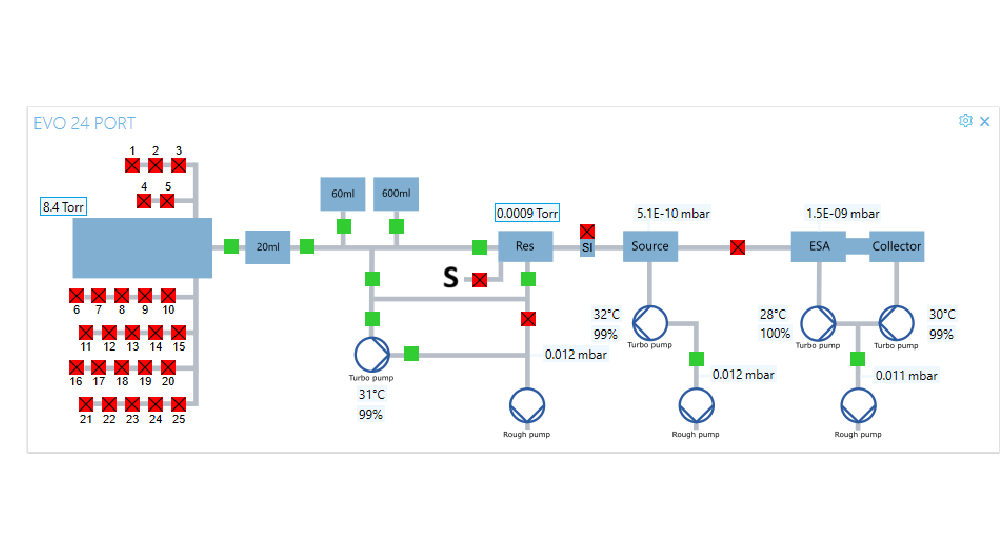
The figure shows an example Evolution inlet system. Individual designs vary according to customer requirements.
System description
Sample bottles, or inlet lines, are connected to any of 24 inlet ports, which are connected via a manifold. All valves shown are computer controlled. Inlet pressure and final reservoir pressure are monitored with two baratrons.
Operation: An aliquot of gas is taken from a specified inlet (to fill the 20 ml volume); then expanded into the 60 or 600 ml volumes to reduce the pressure as required. The final reservoir pressure is typically 0.1 – 0.3 Torr (final reservoir marked ‘Res’, 2 litres).
If required, the system can use the measured inlet pressure to automatically select a filling sequence optimised to fill the final reservoir to a specified pressure.
For very small samples, a sample can be connected directly to the 2 litre reservoir (inlet S on diagram). As an indication of the sensitivity of the technique, the 2 litre reservoir filled to 0.2 Torr contains 0.5 ccSTP of gas.
MS description
- Electron impact Nier source
- Double focussing
- High Mass Resolution: selectable source and collector slits provide resolutions of 220, 1300, 3000 and 5000
- High abundance sensitivity
- Electron multiplier and Faraday (1011 W or 1012 W) available for measurement Can switch between the two automatically, giving very wide dynamic range.
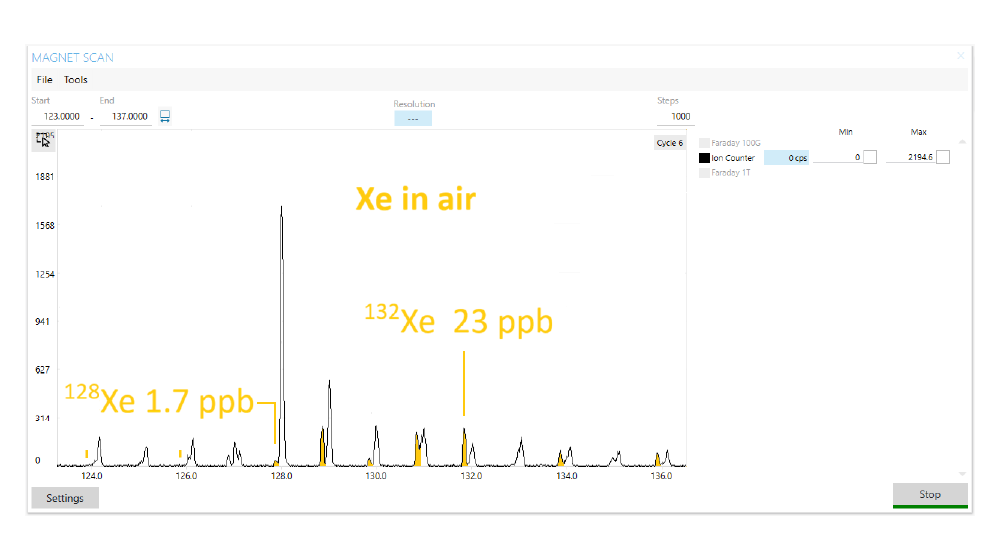
The extremely wide dynamic range is shown clearly in the mass scan: A sample of air was admitted and the reservoir filled to < 0.6 Torr pressure but the sample was not otherwise processed. Xe peaks for masses 128 – 136 are clearly visible and resolved from interferences. 132Xe is 23.4 ppb and 128Xe just 1.7 ppb in air.
Data Acquisition
After the reservoir is filled to the required pressure, the source inlet valve is opened. Gas then flows from the reservoir through a small aperture into the mass spectrometer. The aperture forms a molecular leak (i.e. dimension << mean free path), so that the leak rate for each species is proportional to 1/Ömass.
Data are recorded as peak scans. This was found to be preferable to having the software attempt identification of components of complex peaks in real time. The complete scan is than available for later analysis.
Typical analysis time is 5-10 minutes, after which the inlet is pumped out, ready for the next sample.
Data Processing
Peak positions and heights are usually determined automatically, but for complex peaks the measurement position can be set manually.
As noted above, the signal depletion rate depends on mass, and the peak heights for different masses are automatically corrected back to time zero.
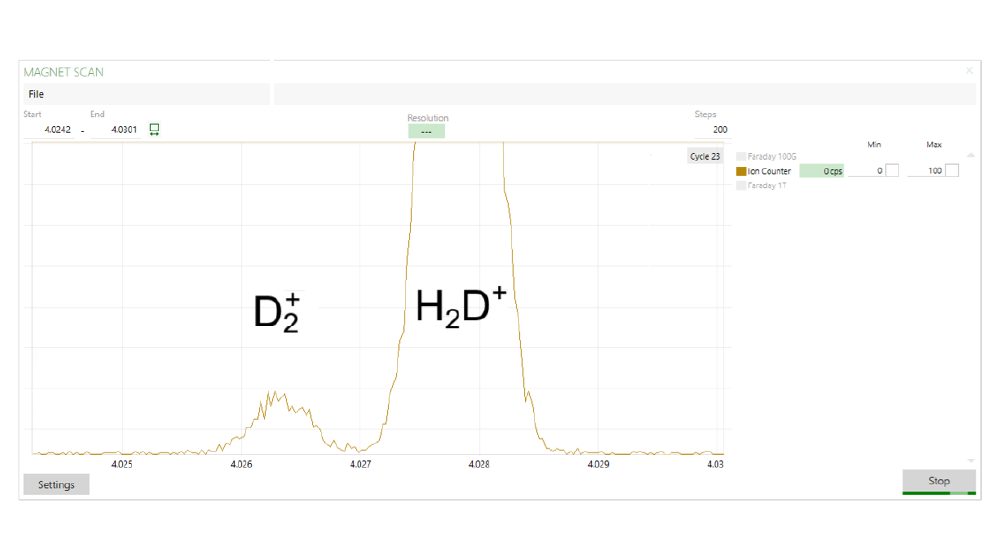
A further example showing the resolution and dynamic range of Evolution: D2 resolved from H2D (m/Dm =2602). This scan was made with H2 of natural isotopic composition.

Application
Nuclear Materials
Evolution is suitable for several applications in the nuclear industry. It is the ideal instrument for measurement of H, D and T isotopologues, as it can resolve all interferences to these species, with the exception of T-3He. It is also suitable for measurement of Kr and Xe isotopes. These are products of U and Pu fission, and their relative abundances provide information on fuel history, making them useful in nuclear forensics. Kr and Xe are also used in ‘tag’ gas to detect leaks in fuel elements in an operating reactor.

Application
Geochemical
Evolution instruments currently use a single detector channel (switchable between Faraday and electron multiplier) and are used for industrial or R&D applications. This differs from the dual inlet and multicollection typically used for geochemical studies. We welcome enquiries seeking to use the high resolution and dynamic range of Evolution for geochemistry, possibly with a different collector array or inlet system

Product
Evolution 2
Evolution is a high resolution gas source mass spectrometer, designed for analysis of gas mixtures with minimal sample processing. As such, the measurement approach is quite different to the IRMS instruments Horizon and Perspective.
Related Resources
